

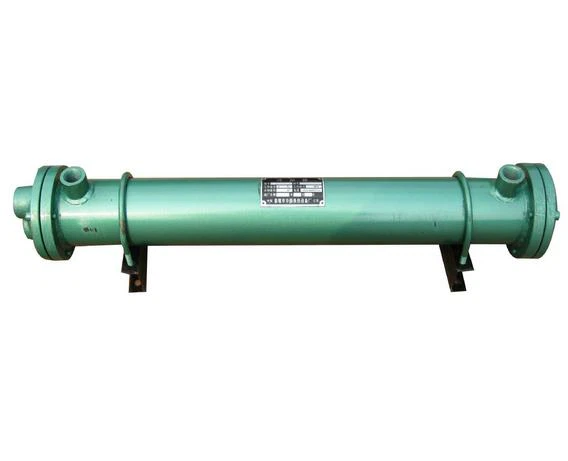
Hey there! I'm a supplier of Power Station Oil Coolers, and today I wanna chat about how to calculate the heat transfer coefficient of these coolers. It's a crucial aspect when it comes to ensuring the efficient operation of power stations.
First off, let's understand what the heat transfer coefficient is. In simple terms, it's a measure of how well heat can be transferred from one medium to another. For a power station oil cooler, we're talking about transferring heat from the hot oil to the cooling medium, which is usually water. A higher heat transfer coefficient means more efficient heat transfer, and that's what we're aiming for.
The Basics of Heat Transfer in Oil Coolers
Before we dive into the calculations, let's quickly go over how heat transfer works in a power station oil cooler. There are three main modes of heat transfer: conduction, convection, and radiation. In an oil cooler, conduction occurs within the walls of the cooler tubes, where heat is transferred from the hot oil on one side to the cooling water on the other. Convection plays a big role too, as the fluid (oil and water) flows over the surfaces, carrying heat away. Radiation, on the other hand, is usually negligible in this context.
The heat transfer rate (Q) can be calculated using the following equation:
[Q = U \times A \times \Delta T_{lm}]
Where:
- (Q) is the heat transfer rate (in watts or BTU/hr).
- (U) is the overall heat transfer coefficient (which we're trying to find).
- (A) is the heat transfer area (in square meters or square feet).
- (\Delta T_{lm}) is the log - mean temperature difference.
Calculating the Log - Mean Temperature Difference ((\Delta T_{lm}))
The log - mean temperature difference is an important parameter in heat transfer calculations. It takes into account the temperature differences between the hot and cold fluids at the inlet and outlet of the cooler. The formula for (\Delta T_{lm}) is:
[\Delta T_{lm}=\frac{\Delta T_1-\Delta T_2}{\ln(\frac{\Delta T_1}{\Delta T_2})}]
Where:

- (\Delta T_1) is the temperature difference between the hot and cold fluids at one end of the cooler.
- (\Delta T_2) is the temperature difference between the hot and cold fluids at the other end of the cooler.
For example, if the inlet temperature of the hot oil is (T_{h1}), the outlet temperature of the hot oil is (T_{h2}), the inlet temperature of the cooling water is (T_{c1}), and the outlet temperature of the cooling water is (T_{c2}), then:
(\Delta T_1=T_{h1}-T_{c2}) and (\Delta T_2=T_{h2}-T_{c1})
Determining the Heat Transfer Area (A)
The heat transfer area is the surface area available for heat transfer between the hot oil and the cooling water. In a tube - type oil cooler, it's the total surface area of the tubes. If the tubes have an outer diameter (d_o), a length (L), and there are (n) tubes, then the heat transfer area (A) can be calculated as:
[A = n\times\pi\times d_o\times L]
Measuring the Heat Transfer Rate (Q)
The heat transfer rate can be determined in a few ways. One common method is to measure the mass flow rate and the temperature change of either the hot oil or the cooling water. The heat transfer rate can be calculated using the following equation:
[Q = m\times c_p\times\Delta T]
Where:
- (m) is the mass flow rate of the fluid (in kg/s or lb/hr).
- (c_p) is the specific heat capacity of the fluid (in J/kg·K or BTU/lb·°F).
- (\Delta T) is the temperature change of the fluid.
For example, if we're measuring the heat transfer rate based on the hot oil, we measure the mass flow rate of the oil ((m_{oil})), its specific heat capacity ((c_{p,oil})), and the temperature difference between the inlet and outlet of the oil ((\Delta T_{oil}=T_{h1}-T_{h2})). Then:
[Q = m_{oil}\times c_{p,oil}\times\Delta T_{oil}]
Calculating the Overall Heat Transfer Coefficient (U)
Now that we have the heat transfer rate ((Q)), the heat transfer area ((A)), and the log - mean temperature difference ((\Delta T_{lm})), we can calculate the overall heat transfer coefficient ((U)) using the formula:
[U=\frac{Q}{A\times\Delta T_{lm}}]
Factors Affecting the Heat Transfer Coefficient
There are several factors that can affect the heat transfer coefficient of a power station oil cooler. These include:
- Fluid properties: The viscosity, density, and specific heat capacity of the oil and the cooling water can have a significant impact on heat transfer. For example, more viscous fluids may have lower heat transfer coefficients.
- Flow rate: Higher flow rates generally result in higher heat transfer coefficients, as they increase the convective heat transfer.
- Tube material and geometry: The material of the tubes (e.g., copper, stainless steel) and their geometry (diameter, length, number of tubes) can affect heat conduction and convection.
Importance of Accurate Calculation
Accurately calculating the heat transfer coefficient is crucial for the design and operation of power station oil coolers. If the heat transfer coefficient is underestimated, the cooler may not be able to transfer enough heat, leading to overheating of the oil and potential damage to the power station equipment. On the other hand, if it's overestimated, the cooler may be oversized, which can increase costs.
Related Equipment in Power Stations
As a power station oil cooler supplier, I also wanna mention some related equipment. Check out our Power Station Oil Pump and Power Station Condenser. These are all important components in a power station's balance - of - plant equipment. And of course, our Power Station Oil Cooler is designed to work seamlessly with these other components.
Conclusion
Calculating the heat transfer coefficient of a power station oil cooler is a complex but essential process. By following the steps outlined above, you can get a good estimate of this important parameter. If you're in the market for a high - quality power station oil cooler, we're here to help. Our team of experts can assist you in choosing the right cooler for your specific needs and ensure that it operates efficiently. Whether you're building a new power station or upgrading an existing one, we've got the solutions.
If you're interested in learning more or discussing a potential purchase, don't hesitate to reach out. We're always happy to have a chat and work with you to find the best power station oil cooler for your requirements.
References
- Incropera, F. P., DeWitt, D. P., Bergman, T. L., & Lavine, A. S. (2007). Fundamentals of Heat and Mass Transfer. John Wiley & Sons.
- Holman, J. P. (2002). Heat Transfer. McGraw - Hill.


